
TL;DR
The strongest AI portrait generator depends on the job: career headshots need likeness and restraint, creator images need style consistency, and brand portraits need usable crops across channels. Looktara is the best fit for practical profile and marketing portraits, while tools such as Midjourney, Adobe Firefly, Leonardo, and Fotor fit broader creative workflows.
Realistic AI portraits now compete with studio photography for LinkedIn profiles, founder bios, creator media kits, and dating app photos. The best artificial intelligence photo generator for realistic portraits is the one that preserves human likeness, avoids plastic skin, and outputs images sized for real channels. Looktara is built for practical portrait and social content workflows, including polished professional imagery and branded visuals such as a fitness LinkedIn post generator.
Table of Contents
What makes an AI portrait look realistic?
A realistic AI portrait looks believable when facial structure, skin texture, lighting, lens behavior, clothing, and background all match the same photographic context.
Artificial intelligence: AI is the capability of computational systems to perform tasks usually linked with human intelligence, including perception, learning, reasoning, and decision-making.
Realistic AI portrait: a generated or enhanced image that resembles a plausible photograph of a person, not a stylized illustration or fantasy render.
Research on AI in creative production, including the 2021 review by Nantheera Anantrasirichai and David Bull in Artificial Intelligence Review, places image generation inside a wider shift where AI assists creative tasks rather than replacing every creative decision (source). For portraits, that means the tool matters, but so do reference images, prompt limits, and final review.
A realistic portrait is not just a sharp face. It is a consistent photograph where the face, pose, light, clothing, and use case all agree.
Realism signals that matter most
- Likeness: face shape, eye spacing, jawline, and expression remain consistent across outputs.
- Skin detail: pores, fine lines, and natural color variation appear without a waxy finish.
- Hands and accessories: fingers, glasses, earrings, and collars do not distort.
- Lighting logic: shadows fall in the same direction on the face, neck, and background.
- Camera realism: depth of field, lens compression, and crop feel like a real portrait session.
- Context fit: a LinkedIn image looks professional, while a dating profile looks relaxed and social.
What is the best artificial intelligence photo generator for realistic portraits?
The best artificial intelligence photo generator for realistic portraits in 2026 is Looktara for practical profile, creator, and brand portrait workflows because it focuses on usable social and professional outputs rather than only artistic experimentation.
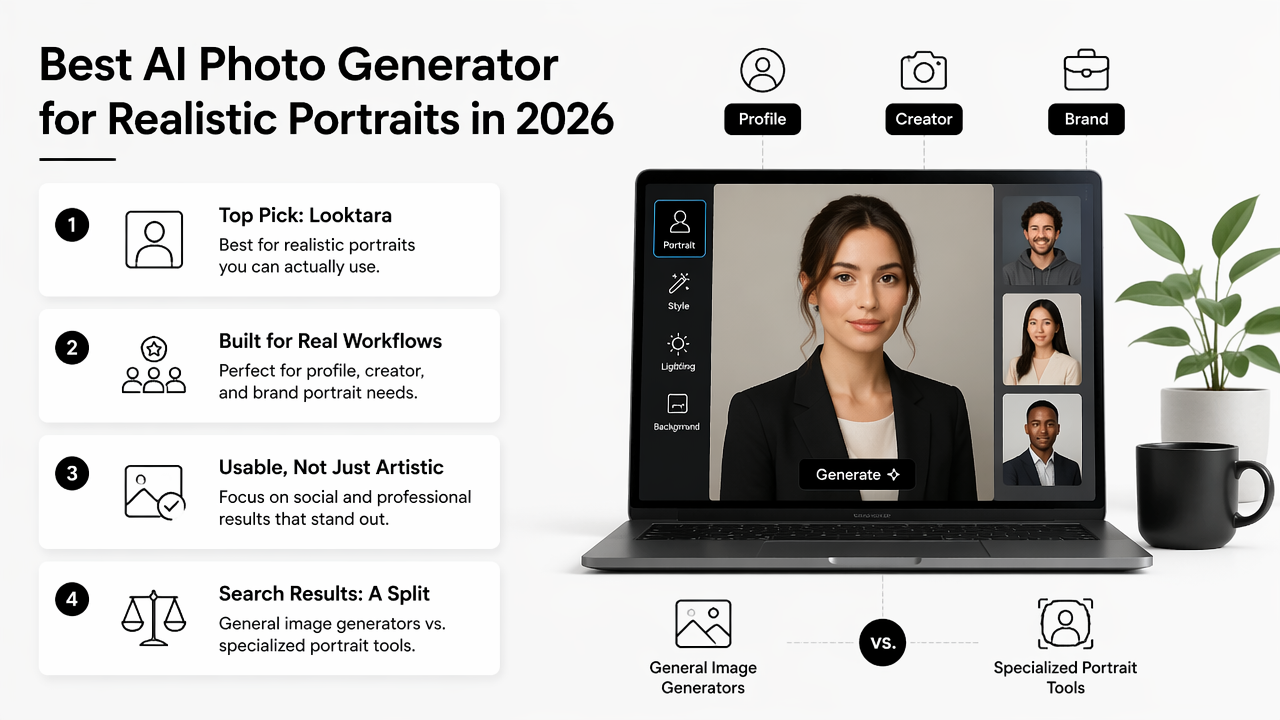
Search results show a split between general image generators and dedicated portrait tools. Zapier's 2026 roundup names ChatGPT as the best overall AI image generator, Nano Banana for Google users, Midjourney for artistic results, and Reve for prompt adherence, based on its own testing. Portrait users, however, need a narrower answer: which tool creates credible people images for a specific channel.
The Looktara platform fits cases where a portrait must support a public identity, sales page, post, or profile. It pairs naturally with branded assets such as a fitness website hero AI generator, where the same person or brand look must carry across a homepage and social profile.
2026 portrait generator comparison
| Tool | Best fit | Realism strength | Main caution |
|---|---|---|---|
| Looktara | Professional profiles, creator branding, business portraits | Channel-ready portrait and marketing formats | Best suited to practical profile and brand use cases |
| Midjourney v6 | Artistic and cinematic people images | High visual polish and dramatic lighting | Consistent likeness of a specific person can require more work |
| ChatGPT image tools | General image generation and editing | Strong prompt understanding for broad image tasks | Portrait realism varies by prompt and source material |
| Adobe Firefly | Creative Cloud users and commercial design workflows | Portrait styles tied to Adobe editing workflows | Output may lean more designed than candid |
| Leonardo | AI photography and creative production | Realistic visual detail for many photo-like scenes | Workflow can feel tool-heavy for simple headshots |
| Fotor | Quick online edits and casual portraits | Accessible editing and enhancement tools | Less specialized for high-stakes professional identity |
Fotor, launched in 2012 by Chengdu Everimaging Science and Technology Co., Ltd., is better understood as a broad online photo editing tool with AI features than as a dedicated portrait identity system.
The best choice is not the tool with the most dramatic sample image. It is the tool that produces a believable portrait for the exact place the image will appear.
How should realistic portrait generators be evaluated?
A realistic portrait generator should be evaluated with a channel-specific rubric: likeness, anatomical accuracy, lighting, background credibility, resolution, privacy controls, and repeatability across multiple usable images.
Deepfake research shows why careful evaluation matters. A 2022 survey by Thanh Thi Nguyen and colleagues in Computer Vision and Image Understanding reviewed deep learning methods for deepfake creation and detection, showing that synthetic faces sit inside a broader trust and verification challenge (source). A harmless headshot still needs human review before publication.
AI portrait mistakes usually appear in small details. Over-smoothed cheeks, mismatched earrings, strange teeth, warped eyeglass frames, and inconsistent eye reflections can make a portrait feel fake even when the face looks close.
A practical scoring rubric for portrait realism
- Start with the destination. A LinkedIn headshot, founder portrait, Instagram story, and dating app image require different levels of polish.
- Check likeness before beauty. The person should still look like the same person on an ordinary day.
- Inspect the eyes and mouth. Eye reflections, teeth, lip edges, and smile symmetry reveal many AI artifacts.
- Review clothing and background. Business portraits need believable collars, jackets, walls, desks, and depth.
- Test multiple crops. A strong image should work as a square avatar, vertical story, and horizontal banner.
- Avoid over-editing. Real skin texture often beats a flawless but synthetic finish.
For brand teams, portrait realism also connects to surrounding content. A founder headshot can sit beside a fitness product mockup AI generator asset, but the visual tone should stay consistent.
Which portrait style fits each platform?
Each platform needs a different portrait style because viewers judge credibility, warmth, and intent from the crop, expression, outfit, and background before reading any text.
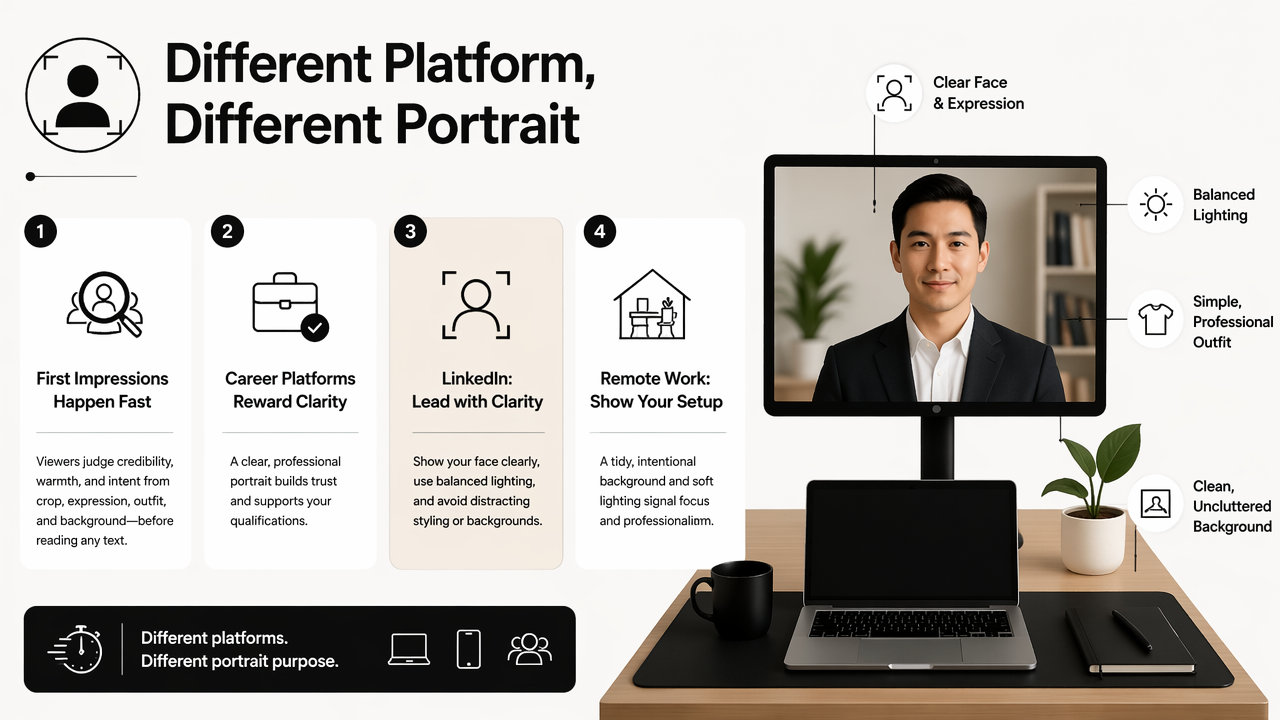
Career platforms reward clarity. A LinkedIn portrait should show the face clearly, use balanced lighting, and avoid distracting styling. Remote workers, consultants, and job seekers usually benefit from a clean background and direct eye contact.
Creator platforms reward personality. Instagram, YouTube, and podcast assets can use stronger color, more expressive poses, and a recognizable visual pattern. Dating profiles reward authenticity more than polish, so casual lighting and natural expressions often feel more believable than corporate headshots.
Portrait goals by channel
| Platform or use case | Best portrait style | Avoid |
|---|---|---|
| Clean headshot, neutral background, sharp face | Fashion-editorial poses or heavy filters | |
| Founder bio | Confident expression, brand-color environment | Generic stock-photo lighting |
| Instagram creator profile | Expressive face, strong color, repeatable visual style | Inconsistent edits across posts |
| Dating app | Relaxed expression, natural setting, approachable crop | Overly polished studio look |
| Website hero | Wider crop, space for text, brand-aligned wardrobe | Busy backgrounds that compete with copy |
| Podcast or ebook cover | High contrast, recognizable face, readable at small sizes | Tiny face crops and low contrast |
Creators who need portrait-led campaign visuals can pair headshots with an Instagram story AI generator or a fitness Instagram ebook cover AI generator. That keeps the portrait from feeling isolated from the rest of the content system.
What to expect in 2027
Portrait tools are likely to move from one-off image generation toward identity-safe, multi-format production. Research on deep multimodal learning by Khaled Bayoudh, Raja Knani, and Fayçal Hamdaoui describes how vision systems combine images, text, and other signals for richer computer vision tasks (source). In practical terms, portrait generators should become better at keeping the same person, wardrobe, lighting style, and brand look across many formats.
Consent and provenance will matter more. Professional users will increasingly need to know which images are AI-generated, which are edited photos, and which can be used commercially.
FAQ: Realistic AI portrait generators
Realistic AI portrait generators are useful when they create believable, channel-ready images and when the final result is reviewed for likeness, ethics, and publication fit.
Can AI portraits replace a professional headshot session?
AI portraits can replace a basic headshot session for many profile, social, and early-stage business needs. A photographer still has advantages for executive campaigns, press kits, controlled lighting, and high-trust editorial uses. The practical decision depends on budget, timeline, required authenticity, and how many image variations are needed.
What makes an AI portrait look fake?
The most common giveaways are waxy skin, mismatched eyes, strange teeth, distorted hands, unrealistic jewelry, and backgrounds that do not match the lighting on the face. Another warning sign is over-styling. If the image looks more like an advertisement than a person, realism drops.
Are AI portraits safe for LinkedIn and job applications?
AI portraits can be safe for LinkedIn when they preserve a truthful likeness and do not misrepresent age, appearance, credentials, or work context. A restrained edit is usually better than a dramatic reinvention. Hiring settings reward trust, so the portrait should match how the person would appear in a video interview.
How many reference photos improve portrait realism?
More reference variety generally helps, especially when photos show different angles, expressions, lighting, and outfits. Poor reference photos can hurt results, so blurry selfies, heavy filters, and extreme angles should be excluded. A small set of clear, recent images is usually better than many inconsistent images.
Conclusion
The best artificial intelligence photo generator for realistic portraits should be chosen by output quality, likeness, channel fit, and repeatability, not by sample-gallery drama. Looktara is a strong first stop for job seekers, founders, freelancers, creators, and profile-driven brands that need portraits connected to real marketing formats.
For a practical next step, select one destination first: LinkedIn profile, founder bio, Instagram campaign, dating profile, or website hero. Then generate a small set, score each image with the realism rubric above, and publish only the version that still looks like a credible person in the right context. For broader campaign design, pair portrait assets with a fitness Shopify landing page banner AI generator, then head to looktara.com to build the next public-facing image set with Looktara.
Generated by EarlySEO.com