
TL;DR
An AI profile picture should match the personal brand, not just make a selfie look polished. The best results come from clear brand positioning, platform-specific crops, realistic styling, and consistent visual assets across LinkedIn, social media, pitch materials, and ads.
A strong profile photo now works like a tiny brand campaign: it has to signal trust, style, and context before a bio gets read. An ai profile picture generator for personal brands helps job seekers, founders, creators, freelancers, and dating app users turn casual selfies into platform-ready images with a consistent visual point of view. Looktara fits that workflow by pairing personal-brand image creation with adjacent brand assets for social and business content.
AI profile picture generator: software that uses generative artificial intelligence to create or enhance profile images from selfies, prompts, style choices, or brand directions.
Avatar: a graphical representation of a person or persona used across digital communities, apps, and profiles.
Key insight: the best AI profile photo is not the most dramatic one; it is the one that makes the person's intended role instantly legible.
Table of Contents
What is an AI profile picture generator for personal brands?
An AI profile picture generator for personal brands creates polished, platform-ready portraits that express a person's professional role, public identity, or social positioning. In 2026, the strongest tools go beyond background removal and face retouching by helping match image style to audience expectations.
Personal branding changes the goal. A recruiter needs credibility cues. A founder needs clarity and confidence. A creator may need energy, color, and recognizability. A dating profile needs warmth without looking staged.
Research on artificial intelligence in creative industries by Nantheera Anantrasirichai and David Bull reviewed how AI supports media generation, editing, and creative production workflows, not just automation (Artificial Intelligence Review, 2021). That distinction matters for profile photos because the tool should support identity design, not erase personality.
Core terms that affect profile-photo choices
| Term | Plain-English meaning | Why it matters |
|---|---|---|
| Headshot | A close portrait focused on face, expression, and upper body | Best for LinkedIn, resumes, speaker pages, and founder bios |
| Profile picture | A smaller identity image used across apps and social platforms | Needs strong crop, contrast, and instant recognition |
| Personal brand | The public pattern of signals associated with a person | Guides clothing, color, expression, and background |
| AI slop | AI-made content perceived as low-effort, low-quality, or meaningless | Overprocessed portraits can damage trust |
| Brand kit | A set of repeatable visual rules such as colors, fonts, and image style | Keeps profile photos aligned with posts, covers, and ads |
A profile image should feel connected to the rest of the person's presence. A fitness coach, for example, may pair a clean portrait with a matching fitness logo concept, while a social creator may need the same photo style reflected in Instagram posts and story graphics.
How should a personal brand choose an AI photo style?
A personal brand should choose an AI photo style by starting with the audience, then selecting expression, clothing, background, crop, and color to support that audience's expectations. Style should be intentional before any generator prompt is written.
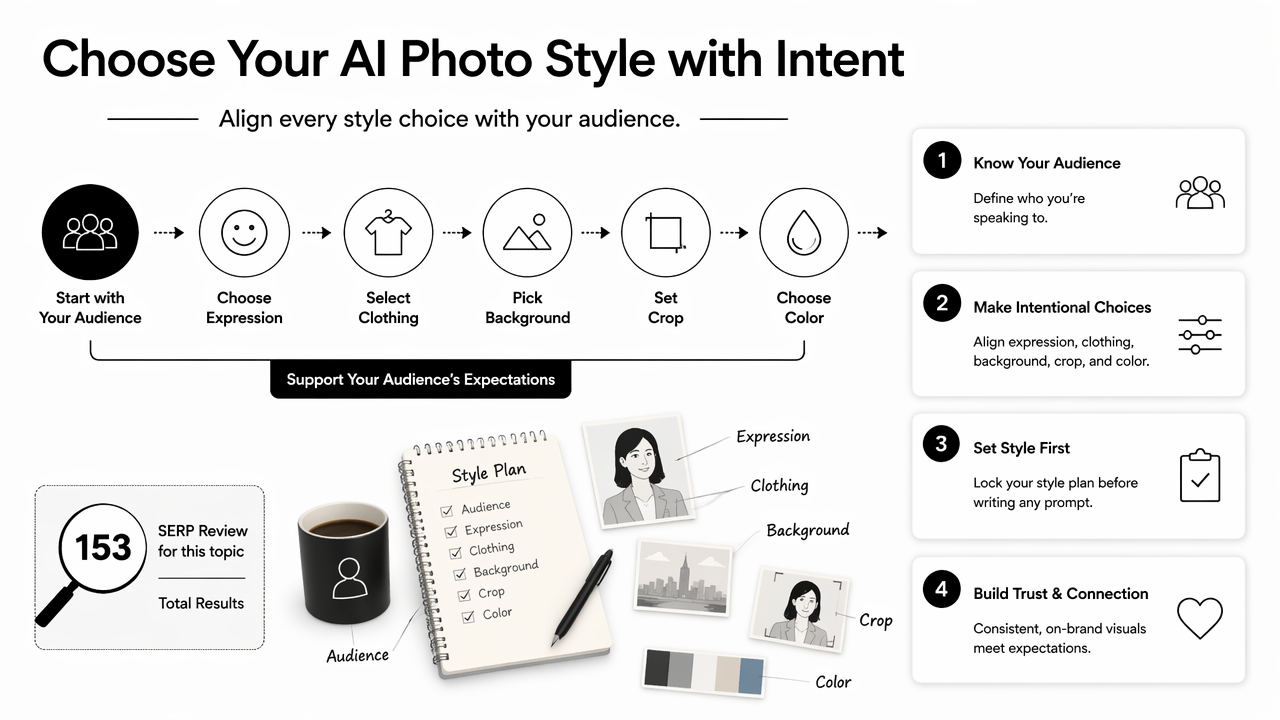
A SERP review for this topic found 153 total results, with many top pages centered on free headshot generation, style variety, or fast LinkedIn photos. The gap is guidance. Most tools explain how to create a profile image, but fewer explain which image should represent a specific brand position.
Personal-brand archetypes and photo direction
| Brand archetype | Best expression | Best setting | Avoid |
|---|---|---|---|
| Job seeker | Calm, open, confident | Neutral office or soft studio | Heavy filters, loud backgrounds |
| Founder | Direct, energetic, composed | Modern workspace or clean gradient | Overly casual selfies |
| Creator | Expressive, bright, memorable | Color backdrop or lifestyle scene | Generic corporate styling |
| Freelancer | Approachable, skilled, focused | Desk, studio, or craft context | Images that hide face details |
| Dating profile user | Warm, relaxed, natural | Outdoor or lifestyle background | Plastic skin, fantasy lighting |
Strong prompts include identity signals. A founder might ask for a clean studio portrait with natural skin texture, smart-casual clothing, and a subtle tech-office background. A wellness creator might choose soft daylight, earth tones, and a relaxed smile, then extend that style into a fitness Instagram post.
A simple style-selection process
- Define the primary platform: LinkedIn, Instagram, X, TikTok, founder website, or dating app.
- Pick one audience outcome: trust, approachability, authority, creativity, energy, or warmth.
- Choose clothing that matches the audience outcome, not a random fashion trend.
- Select a background with low visual clutter and strong contrast.
- Generate several variations, then reject anything that changes facial identity.
- Crop the winning image for each platform before publishing.
Best practice: one polished master image rarely fits every channel. Each platform needs a crop and tone that match how the image will be seen.
Which features matter most in a personal-brand photo generator?
The best personal-brand photo generator combines realistic identity preservation, platform-specific exports, style control, and brand consistency features. Fast generation matters, but credibility depends on whether the image still looks like the real person.
Competitor pages in the current SERP commonly highlight free tools, seconds-fast output, LinkedIn use cases, and many styles. Those features are useful, but personal-brand work needs a stronger creative brief.
Feature checklist for 2026 buyers
- Identity consistency: the face should remain recognizable across all variations.
- Natural skin and hair rendering: polished should not mean waxy or artificial.
- Platform crops: square, vertical, and banner-friendly exports reduce rework.
- Prompt control: users need control over clothing, background, lighting, and mood.
- Brand color support: colors should match posts, ads, website visuals, and covers.
- Commercial fit: entrepreneurs and creators need images usable beyond a single profile.
The Looktara platform is useful when a profile picture is part of a larger content system. A fitness entrepreneur, for example, can align a portrait with a TikTok cover design, social posts, and promotional visuals instead of treating the headshot as a one-off asset.
Common tool types compared
| Tool type | Best fit | Strength | Limitation |
|---|---|---|---|
| AI headshot generator | LinkedIn, resumes, speaker pages | Professional polish | Can feel generic if style choices are narrow |
| AI profile picture maker | Social apps, creator profiles, dating apps | Wider creative range | Some outputs may look less realistic |
| Brand-image generator | Entrepreneurs and creators | Keeps visual identity consistent | Requires clearer brand direction |
| General AI image tool | Experiments and concepting | Flexible prompting | More manual editing and quality checks |
A 2023 review by Esma Aïmeur, Sabrine Amri, and Gilles Brassard examined misinformation and disinformation on social media (Social Network Analysis and Mining, 2023). Profile images are not the same as news content, but authenticity signals still matter because people judge whether a digital identity feels credible.
How can AI profile photos avoid looking fake?
AI profile photos avoid looking fake by preserving facial identity, using realistic lighting, limiting retouching, and matching the image to the platform's social context. The goal is believable polish, not a flawless synthetic portrait.
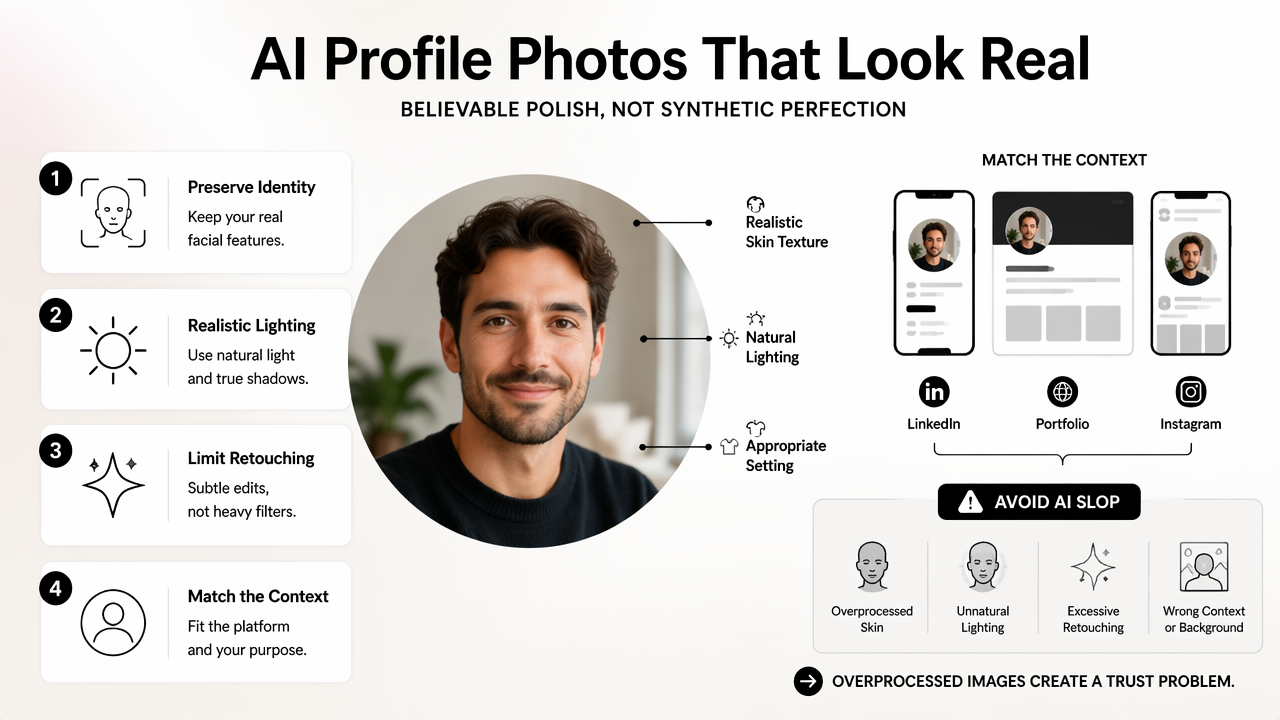
Overprocessed images create a trust problem. The term AI slop is commonly used for generative content that appears low-effort, low-quality, or meaningless. In profile photos, that usually means airbrushed skin, mismatched hands, strange teeth, glossy eyes, or clothing that looks painted on.
Authenticity checklist before publishing
- Face shape, eyes, smile, and hairline still match the real person.
- Skin texture remains visible rather than plastic.
- Lighting direction looks possible and consistent.
- Background perspective does not bend or blur unnaturally.
- Clothing fits the role and does not create false status signals.
- The same person would be recognizable in a video call or in person.
Academic discussion around generative AI quality has raised questions about reliability and evaluation. Jürgen Rudolph, Samson Tan, and Shannon Tan examined ChatGPT and assessment challenges in higher education (Journal of Applied Learning & Teaching, 2023). For personal branding, the practical lesson is simple: generated output still needs human judgment.
Platform-specific realism cues
| Platform | Realism cue | Best crop |
|---|---|---|
| Clear face, business-appropriate clothing, neutral background | Square head-and-shoulders | |
| Strong color, personality, recognizable face | Square or vertical portrait | |
| X | High contrast and simple composition | Tight square crop |
| TikTok | Expressive face and bold visual energy | Vertical cover-friendly portrait |
| Dating apps | Natural smile, relaxed setting, honest styling | Mid-close lifestyle crop |
A creator who uses profile imagery across social channels can extend the same visual system into a fitness Instagram Story. That keeps the face, colors, and message aligned without making every asset identical.
What should personal brands expect from AI profile images in 2027?
Personal brands should expect AI profile images to become more integrated with full visual identity systems in 2027. The strongest workflows will connect headshots, posts, ads, pitch slides, banners, thumbnails, and short-video covers around one consistent brand style.
Google Gemini and similar generative AI systems have made multimodal creation more familiar to the public. As that habit grows, profile-picture tools will likely move from single-image output toward guided identity kits. The winning products will help people choose a believable visual position, then reuse it across formats.
Looktara already points in that direction by connecting personal-brand visuals with business and social formats. A founder can pair a profile image with a pitch deck slide, while a coach can match portrait style to quote posts, ads, and channel graphics on looktara.com.
Signals that a tool is future-ready
- It supports more than one profile size or crop.
- It keeps a consistent face and visual style across outputs.
- It connects portraits with social, sales, and creator assets.
- It allows brand colors, scene choices, and tone controls.
- It encourages realistic review rather than blind publishing.
A profile picture is becoming the entry point to a larger personal-brand system, not a separate design task.
Frequently asked questions
What makes an AI profile picture good for LinkedIn?
A good AI profile picture for LinkedIn looks realistic, professional, and easy to recognize at small size. The face should be clear, the background should be simple, and clothing should match the target role or industry. Overly artistic lighting or fashion-style editing can reduce credibility on a business network.
Can AI-generated profile photos be used for dating apps?
AI-generated profile photos can work for dating apps when they stay authentic and natural. Lifestyle settings, relaxed expressions, and realistic skin texture matter more than studio perfection. A photo that creates a false impression may lead to lower trust once matches move into real conversations.
How many AI profile images should a personal brand create?
Most personal brands benefit from one primary headshot plus three to five supporting variations. The main image can serve LinkedIn or a website bio, while alternates can fit Instagram, X, TikTok, newsletters, speaker pages, and dating profiles. Variation helps avoid a copied-and-pasted visual identity.
Is an AI headshot better than a professional photographer?
An AI headshot is faster and often cheaper, while a professional photographer offers direction, lighting control, and real-world accuracy. The better choice depends on budget, deadline, and risk tolerance. Many professionals use AI for early brand testing, then book a photo session once the style direction is clear.
Conclusion
An ai profile picture generator for personal brands works best when the image starts with positioning, not filters. The safest path is to define the audience, choose a style archetype, generate realistic options, inspect for authenticity, and crop separately for each platform.
For creators, founders, freelancers, job seekers, and personal-brand builders, the next useful step is building a small visual kit rather than a single portrait. Use Looktara to connect profile images with posts, covers, slides, and social assets, then visit looktara.com when the brand needs a consistent set of visuals ready for publishing.
Generated by EarlySEO.com